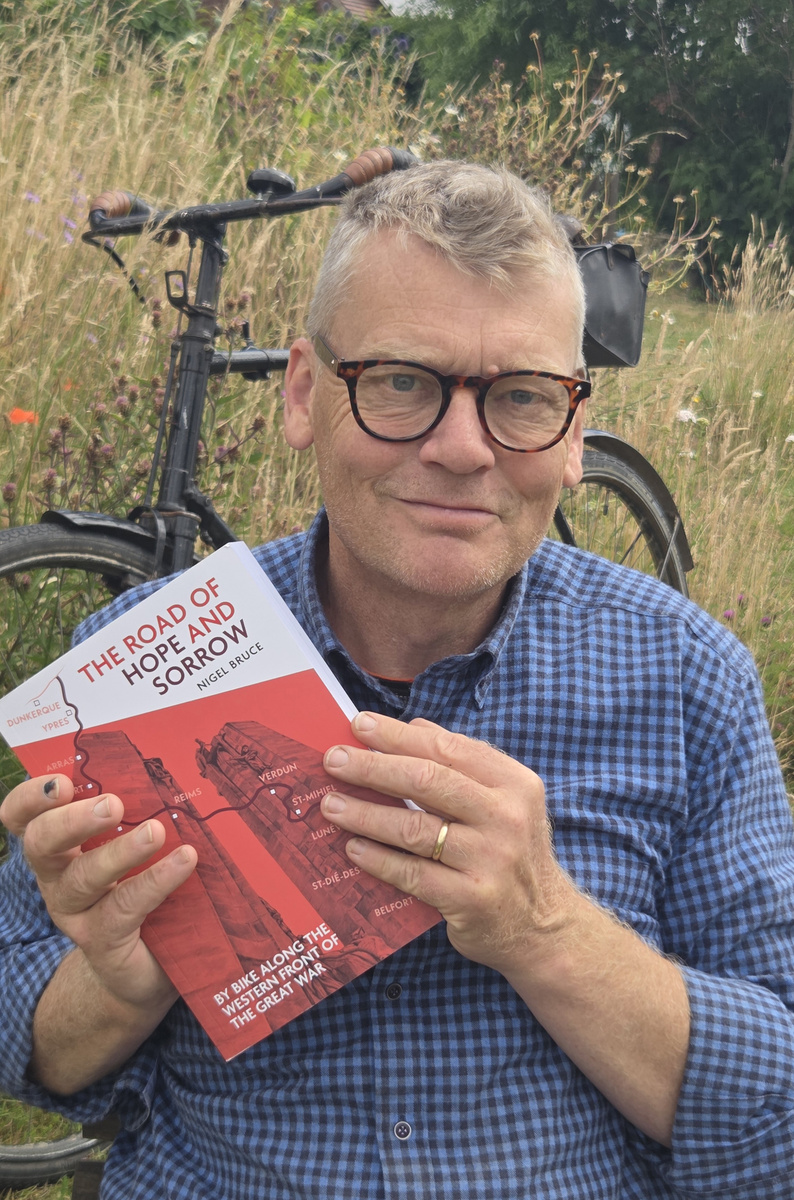
The Road of Hope and Sorrow is a big book in more than one sense. At 524 pages it’s not something you would lightly toss into your bike pannier, despite the wealth of helpful advice it offers on tackling the challenge of cycling the Western Front. Nigel Bruce’s book is also big in its scope and ambition, combining an overview of the First World War; a detailed account of his 1500km bike ride; reflections on his motivation for undertaking the challenge; family history; musings on art and literature as a way of engaging with the War; thoughts on the sense of loss experienced through immersion in the cemeteries and memorials of the Western Front; seeking answers to ‘a whole raft of questions about cause and responsibility’ for the War – and more. As I began reading, I wondered if there might be a danger that these disparate elements would end up competing with each other, resulting a book that was Jack of all trades but master of none.
But the more I read, the more I realized that Bruce had woven these threads into a wholly coherent and compelling narrative – I read the entire book in two days, and by the time I finished I was ready to pack my panniers and head for the Belgian coast. The author’s honesty and sincerity, his absolute commitment to his ‘pilgrimage’ (his own word) in remembrance of the dead, play a large part in creating this work’s appeal. The book’s attractive format – clear layout, cogent chapter summaries, full-colour illustration throughout, with the author’s excellent photographs on nearly every page – also contributes.
Nigel Bruce provides the reader with a raft of well-organised, meticulously-researched factual material. He provides helpful practical advice to the cyclist aiming to ride the Western Front and writes interestingly of key battles and memorials. I particularly enjoyed his detours into the byways of First World War history, for example, Marie Curie’s role: she not only financed twenty X-ray vehicles, the first of which was used at the Battle of the Marne, but also drove, operated and maintained one of them.
However, the thing which really made this book stand out for me was the author's emotional investment in his pilgrimage. He records his personal reactions to the sites of loss and remembrance he encounters, determined to engage with the experiences of all who were affected by the conflict, not just the British and Commonwealth combatants. Ernst Junger’s memoir, Storm of Steel, becomes his route into exploring the German perspective – one of many occasions when Bruce uses literature to illuminate his own responses. The extraordinary memoir written by his wife’s grandfather who fought in the French artillery throughout the War provides insights into the French experience. Sensitive to the impact on non-combatants, he becomes drawn to the ‘villages detruits’, those abandoned villages like Old Craonne, never rebuilt after the War; here he pays tribute to the lives which were destroyed just as surely as those honoured in the military cemeteries.
The idea of reparation is central to this book. As a counterbalance to the sorrow of the cemeteries and other stark memorials to loss, Bruce finds evidence of resilience and hope for the future of Europe. On a visit to Reims Cathedral, re-built after almost complete destruction during the War, he reflects on the significance of Marc Chagall’s stained-glass windows, now flanked by those created by German artist Imi Knoebel for the 800th anniversary of the Cathedral in 2015. Knoebel declined payment for her work and the German government paid for the cost of installing the windows. Bruce sees this as one of many examples of ‘a process of reconciliation’ in post-1945 Europe.
Reflecting in his Epilogue on why he made his epic journey and wrote the book, Bruce lists amongst many other motives his desire to listen to the voices of the dead and to make some contribution to the world of reparation he saw amongst the sorrow and loss. For this reader, he brought vividly to life those lost voices and led me to reflect more deeply not just on the War but its lasting reverberations.