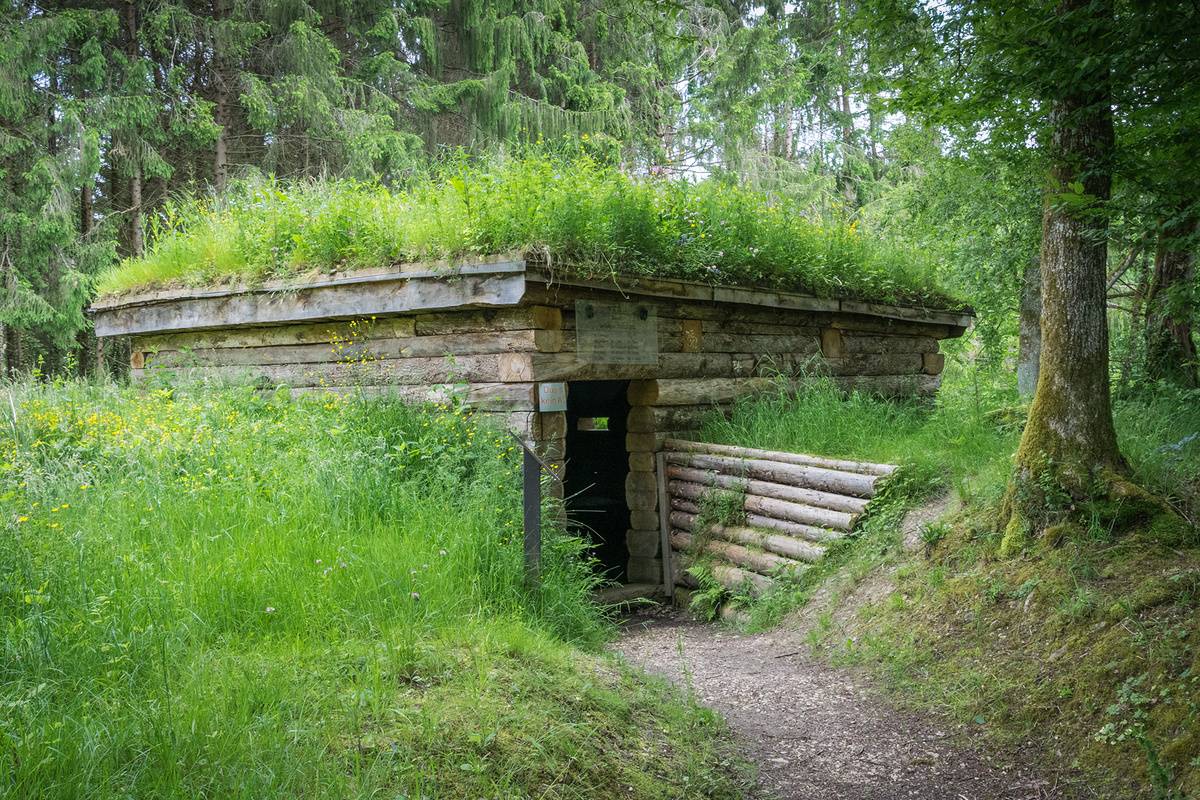
Less than 100 metres from the Swiss border stood a gun emplacement which marked the first German fortification of the Western Front. Or the last, depending on which way you are facing. This featured a revolving cannon, an illustration of which is provided on the information panel nearby (see photo).
I was now past the muddy section and able to ride my bike again. Many years ago, before the outbreak of the Great War, a farm and grocery known as the Petit Largin stood near here on the Swiss side of the border. Around 1890, the owner built an inn opposite his property, but this was just inside Alsace, which at the time was part of the German Empire. The authorities placed a frontier marker stone, one of several along this section of the path, to show that different customs and excise rules applied to the Swiss grocery and the German inn.
Although the farm disappeared around 1900 and the inn was destroyed by German shellfire in 1914, this border crossing was to play an important role in the Second World War. When Gauleiter Robert Wagner announced in 1942 that Alsatian men would have to enlist in the German army, many sought to escape. The salient of Swiss territory provided a well-used route, and on just one day in February 1943, a total of 183 men made it out of Alsace and into neutral Switzerland.
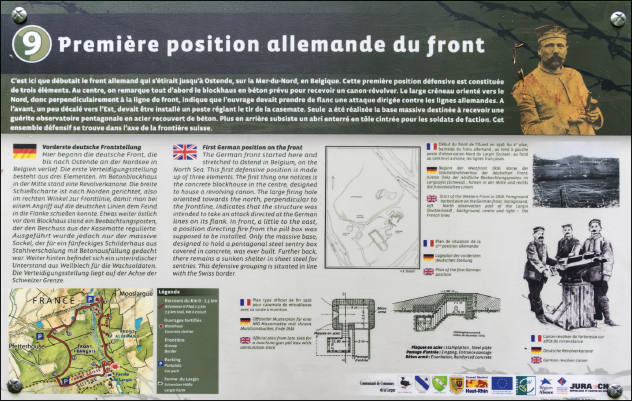
The first (or last for me) German position of the Western Front.
On the far side of the river, in the corner of a field, stands the Largin Farm. It looks somewhat dilapidated now, but peering at it through the trees I could imagine those Alsatian men, desperate to avoid conscription, scrambling across the stream in the depths of a freezing winter night, racing across the field to the sanctuary of the farm, and on to freedom.
It is said that, as they made their escape, they sang ‘Vous n’aurez pas l’Alsace et la Lorraine’ (You will not have Alsace and Lorraine).
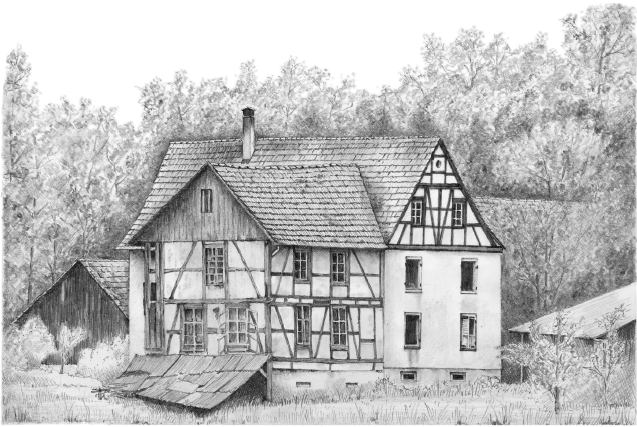
The Largin Farm just inside the Swiss border
by Nigel Bruce
A timber footbridge constructed by Swiss army engineers in 2012 took me over the Largue river and into Switzerland where I found Marker Stone 111.
Placed in 1743, it carries the marks of episodes in the turbulent history of Alsace. Carved on the southern facet is the bear of Berne, signifying the moment in 1815 when the Episcopality of Basel (which includes the nearby community of Bonfol) was incorporated into the Canton of Berne. On the reverse side, the date 1793 recalls the year when the short-lived Rauracian Republic, created in 1792 from part of the Holy Roman Empire located in what is now the Swiss Jura, was annexed by France. The date 1817 on the western side of the marker was added when officials confirmed the border in that year, while other markings on the French side attest to changes of sovereignty.
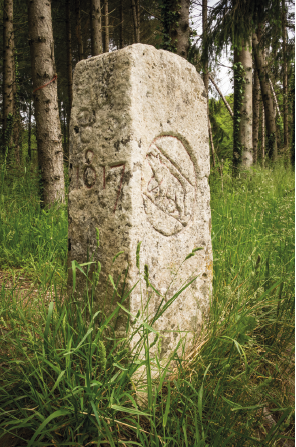
Marker stone 111, placed on the Franco-Swiss border in 1743, its carved sides a witness to the turbulent history of this region and the location of Kilometre Zero
This modest stone held a very special significance for my journey along the Western Front. Planted on the Swiss border between the French and German lines, and watched over by the neutral Swiss, it marks the strange but very real point known as Kilometre Zero.
Beside this stone, I was standing in the midst of a forest of war and peace. Across just a few metres of woodland, political circumstances determined that while French and German citizens would be ordered to kill each other, both could meet, talk and laugh with their Swiss counterparts – as illustrated so poignantly in the information panel at the site. All of the blood, shells, bullets, gas, pain and death just stopped here, on an ill-defined line beside a small stream in the woods of Southern Alsace. Try explaining that to a child.
And to emphasise this extraordinary reality, just across from Marker 111 is Swiss Observation Bunker No. 2. There is nothing left of the original, as it was built from timber and earth since the Swiss needed protection only from stray bullets and the occasional deliberate shot, presumably from a frustrated German or French soldier.